I rent and the apartment flooded. What now?
In a Santa Ana rental, the building is your landlord’s to dry and repair. Drywall, flooring, cabinets, the water heater closet. What you moved in with stays yours, and a renters policy is normally what stands behind a warped dresser.
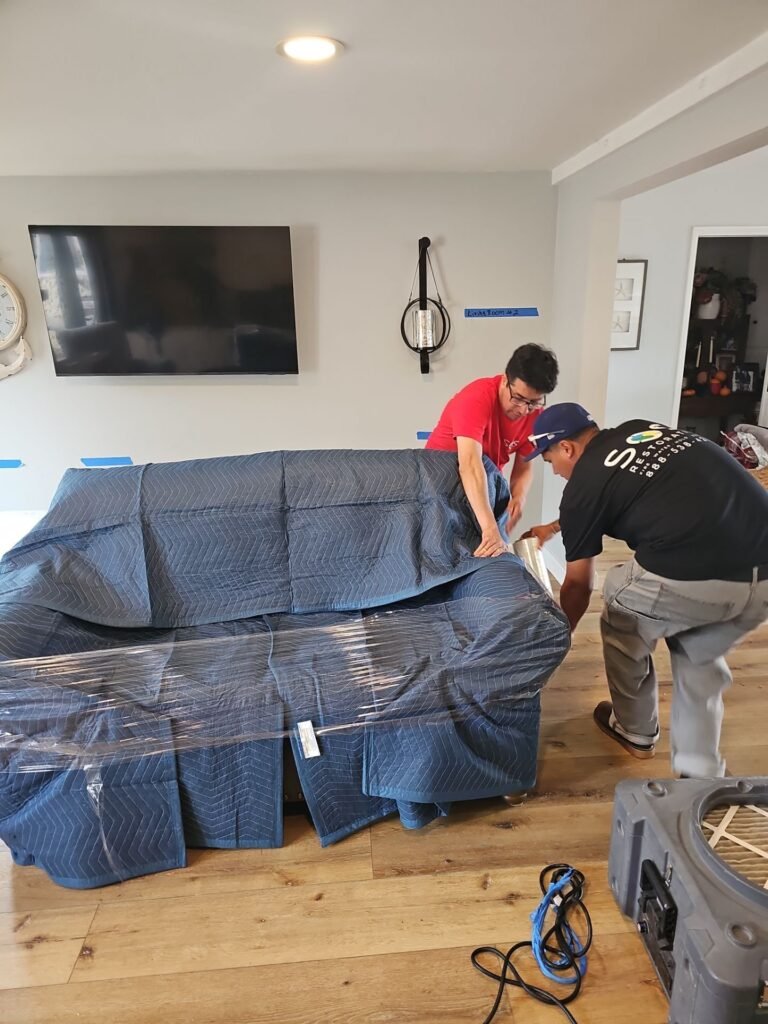
A person answers, day or night. The first look is free. CSLB #1131134 · IICRC #70194273
Who pays for what?
The building is the landlord’s. What you carried in is yours.
That holds in a fourplex off Bristol or a stacked-flat complex near MainPlace. It holds in a house rented out by the family that used to live in it.
What makes it messy is that the two categories touch. A soaked carpet the landlord installed is the building; the rug you bought is yours.
The kitchen cabinets are the building. What was sitting on the bottom shelf inside them is yours.
What counts as the building?
Everything that was there before you signed the lease.
- Drywall, insulation, framing and the baseboard along the bottom of the wall
- Subfloor, plus whatever flooring the unit was rented with
- Fixed cabinets, countertops and the closet doors
- Plumbing inside the walls, the water heater, and appliances the landlord supplied
- Hallways, stairwells, laundry rooms and anything the building shares
Tile, vinyl plank and wall-to-wall carpet all sit on that side of the line.
And what counts as mine?
Everything you carried through the door, including the hard cases.
- Furniture, including the mattress that was sitting on the floor
- Clothes, shoes and whatever was stacked in the closet
- Electronics, the tower under the desk, and the cables behind it
- Books, papers, photographs and documents
- A washer or dryer you brought yourself
- Instruments and tools, which are hard to price and harder to replace
That last line is the one people underestimate until they write the inventory.
Must the landlord fix it?
Generally yes, and it does not turn on whose fault it was.
California landlords are held to a habitability standard, a legal floor for the condition a rented home is kept in. Saturated walls and a wet subfloor are below it.
That duty is about the condition of the property, not about blame. Which is why drying usually starts long before anyone settles who caused it.
What turns the duty into action is notice. Email, a text you keep, a ticket through the portal, so there is a record.
Does the building's policy cover my things?
Almost never. It covers the building and the owner’s interest.
The structure, and sometimes the rent lost while a unit sits empty. Your sofa was never on that policy.
A renters policy answers for your belongings, and most forms do two things people forget they bought. They pay toward replacing property, and they carry a loss-of-use benefit.
Loss of use pays toward a hotel, a short-term rental, or eating out while your kitchen sits under fans. Your declarations page carries the limits, and that sheet has never crossed our desk.
What if I never bought one?
Then the property is on you, unless another policy answers.
A gap like that gets closed by somebody else’s liability coverage, or somebody else’s checkbook.
A neighbor’s policy sometimes answers for it. An owner sometimes pays out of pocket because it costs less than the argument.
Both happen, and neither is something anybody can promise you.
What if it came from my unit?
The building still gets dried. What moves is who pays.
A tub overflowed, an aquarium failed, or a hose you attached worked loose. Most renters policies carry a liability section built for exactly that.
It is the part that answers when your water reaches the unit below. The building’s carrier may come looking for reimbursement afterward.
That has a name, subrogation: one insurance company asking another to hand back what it paid. Age matters too, since a hose that sat on the wall for fifteen years is a different conversation.
Can they take my deposit?
Not for a pipe that failed inside a wall.
A deposit answers for unpaid rent, cleaning, and damage beyond ordinary wear and tear. A failed pipe is none of those.
Repairs the owner’s policy already paid for should not turn up on your move-out statement a second time.
California’s deposit rules require an itemized statement of anything withheld, with receipts or estimates behind it. Read those lines against your own photographs.
Where do I sleep meanwhile?
Probably where you already do, unless power is off or sewage.
Drying takes days rather than hours, and the equipment is loud enough that conversation in the room is work.
How many days comes down to volume and the material it landed in. Also whether anything was opened, and how humid the week turns out.
A unit with two air movers running is usually still sleepable. A unit with the power cut or sewage in it is not.
What do I raise early?
Rent reduction, and help with somewhere to stay.
Neither is automatic, and both settle far more easily before the work finishes than after.
Put both in writing while the fans are still in the hallway.
What do I put in writing?
More than feels necessary, on the first day.
- Photograph every room from the doorway, then close on the water line
- Take a slow video, saying the date out loud as you narrate
- Send written notice the same day, and keep the sent copy
- List damaged belongings item by item, with what you paid and when
- Keep every receipt: the hotel, the laundromat, the meals
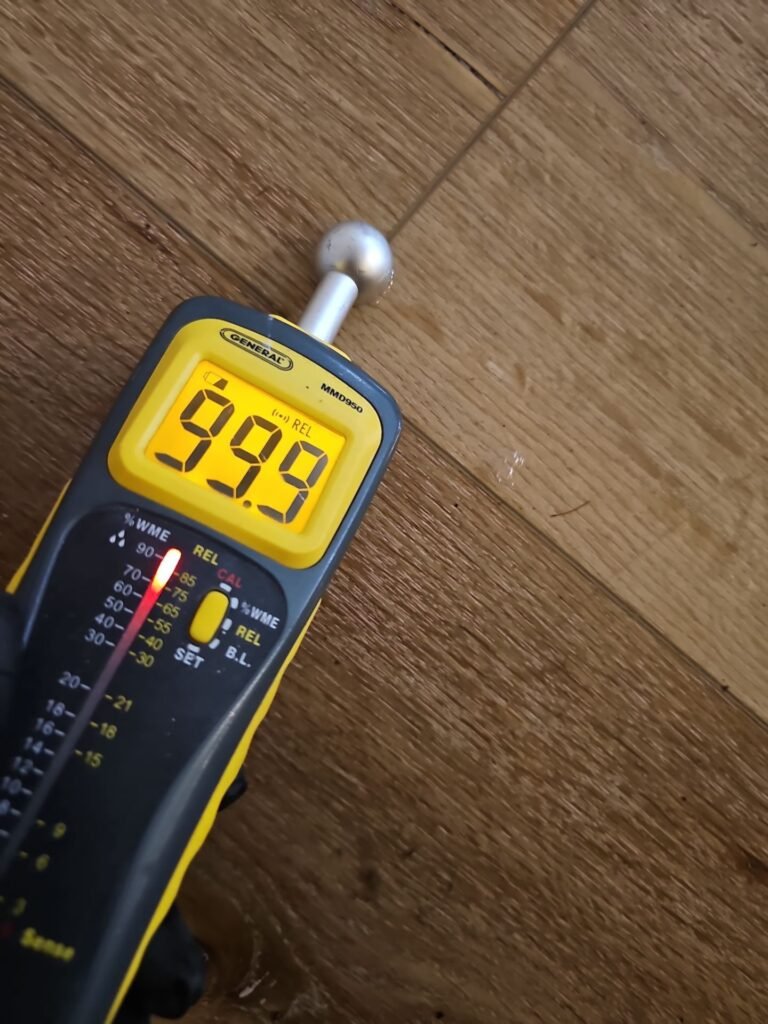
- Ask the drying crew for the daily moisture readings
The record you build in the first hour is the only version that still exists three months later.
Keep a copy of anything you sign, and read it first. What people sign has a way of surfacing later.
A tenant generally cannot authorize work on somebody else’s building. If a crew arrives with a form, the owner or their manager should be signing it.
What can this page not tell me?
Anything living in your lease, your policy, or the house rules.
We do not know whether your landlord lives two blocks away or runs a call center in another state.
That one difference changes almost everything about the next month.
What a carrier finally pays on your belongings gets settled weeks after the fans leave. Anyone handing you that number today is making it up.
What the equipment is doing is on the restoration page. If you rent from an owner inside an association, the condo split is worth a read. The guides pick up where this one stops.
Slab Leak Signs: How Do I Know I Have One?
Garage Water Heater Burst: How Bad Is It?
Santa Ana Permits Before the Wall Closes
What lasts is your own dresser back against a dry wall, a deposit that came back whole, and an inventory nobody made you rebuild from memory. Santa Ana, (949) 522-4470.

Water, fire, smoke, mold, storm and sewage cleanup for Santa Ana and the Orange County cities around it. Any hour, any day. Se habla español.