What clears before the wall closes here?
Open framing looks like progress. In Santa Ana it is a checkpoint. Three questions settle before board goes back up. Does the city want a permit? Was the old material sampled? Is the paint leaded? None of the three is optional here.
A person answers, day or night. The first look is free. CSLB #1131134 · IICRC #70194273
Does a repair need a permit?
Yes, because the word repair sits in the trigger sentence.
Santa Ana’s permit language reaches anyone who wants to construct, enlarge, alter, repair, move or demolish a building.
The back half catches the trades: installing, altering, repairing, removing or replacing any electrical, gas, mechanical or plumbing system.
Pull cabinets after a supply line lets go, swap copper, move a receptacle. You have touched two of the four.
That is how a modest water damage repair reaches the counter. A fire and smoke loss almost never avoids it.
Is there a second trigger?
Yes, and it comes from the air district, not the city.
Rule 1403 treats removal of any load-supporting member as demolition. Take one stud out of a bearing wall and, on paper, you are demolishing.
State law then blocks the city from issuing a demolition permit. Not until the owner produces the notification already filed with the district.
Asbestos paperwork gates building paperwork. Geography decides which counter you stand at, and the Planning and Building Agency here sits at 20 Civic Center Plaza.
What is actually exempt?
A short list, and drywall is not on it.
- Painting, wallpaper, tile, carpet, cabinets and countertops, finish work only
- A detached single-story shed of 120 square feet or under
- Fences seven feet or lower, with front yards still answering to Planning
- A retaining wall four feet or lower, footing to top
- Sidewalk and driveway no higher than 30 inches over the grade beside it
- Movable partitions and fixtures five feet nine inches or shorter
Hunt for drywall there. Framing, wire, pipe and duct do not appear either.
Santa Ana grants no square-footage allowance for board. There is no magic footage you can cut and stay clear.
Remember that after a storm loss, or when a line backs up and forces a sewage cleanup.
A flood cut runs low and narrow and looks like nothing. Two feet of board off a hallway is still a repair.
What is a plan check?
A reviewer measuring your drawings against code before anyone builds.
Corrections come back, you fix them, and the set goes in again. Santa Ana sorts work by whether that loop is needed at all.
When it is not, the counter can issue on the spot through the express program. Your application has to be finished before you walk in.
It covers single-family houses, townhomes, condominiums, duplexes and existing commercial. Arriving with blanks burns the trip.
Who is shut out of express?
The oldest houses in town, which is the cruel part.
The express lane is closed to the historic register and to contributive properties. Also to historic districts, and to the SD-19 and SD-40 zones.
Those are French Park and Heninger Park. They hold the oldest stock in town, and the material likeliest to need sampling.
Everything else goes into review. The package runs heavier than owners expect.
- The application and the plan check submittal form
- Plans and specifications, with structural calculations
- Title 24 energy calculations
- Mechanical, electrical and plumbing drawings, turned in as separate sets
How long does it hold a job?
The city puts no promise in writing, so neither will we.
Expediters advertise ranges from days to past a month. That is their tally of old jobs, not a commitment from the counter.
What Santa Ana does put in writing is the far edge. A permit goes void if work has not begun within 180 days of issuance.
It goes void again if the job sits abandoned for 180 days.
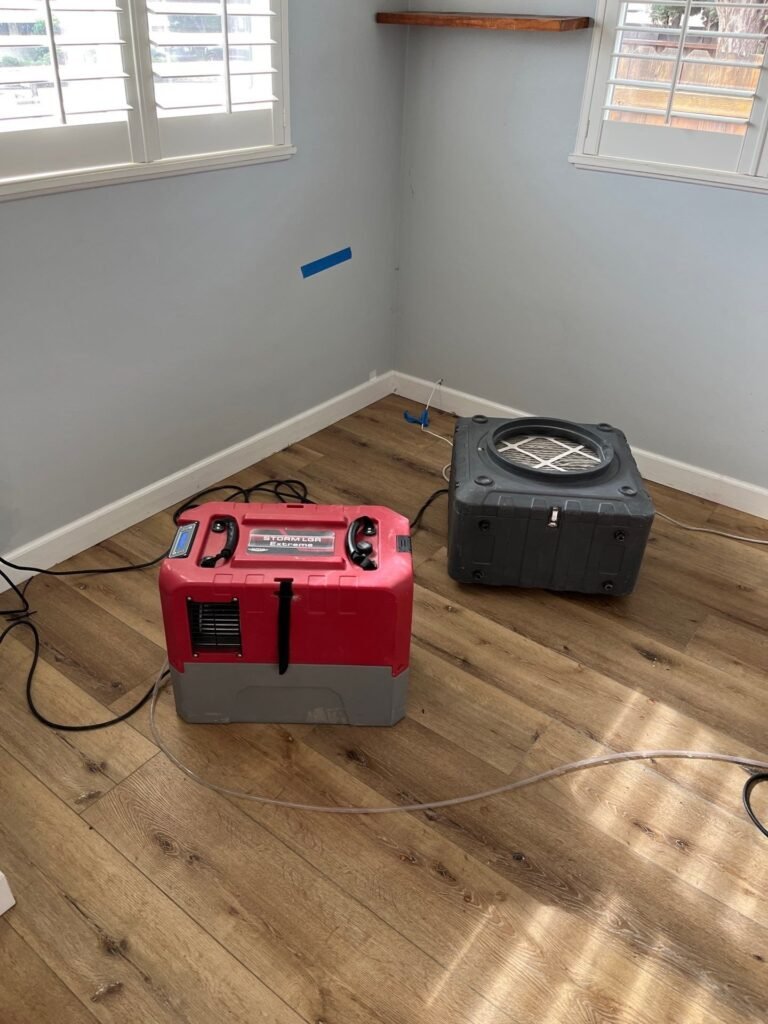
Fans on the floor and drawings on a desk compete for nothing. Start the reconstruction set while equipment is still humming.
What gets tested in a sixties house?
Asbestos and lead, on two rules with two cutoff years.
A sixties building here is typical, not unusual. Roughly nine of every ten homes in Santa Ana went up before 1980.
The thickest band landed between the forties and the sixties. Cal/OSHA presumes asbestos in surfacing material and pipe insulation in anything raised in 1980 or earlier.
Surfacing material means finishes sprayed or troweled on: acoustic ceiling texture, fireproofing over steel. Presumed is a legal word with one exit.
A sample, a laboratory, a written result.
Does the air district exempt houses?
Barely, and not the ones most of this city lives in.
Rule 1403 wants a written survey ahead of any renovation or demolition, signed by an asbestos consultant the state credentials.
One exception covers a residential single unit dwelling, and only under 100 square feet of material still intact.
The air district states flatly that owners of condominiums, townhouses and apartments receive nothing from it. Santa Ana is over half renters, dense with duplexes and stacked units.
For the rest, water closes the door anyway, because the exception rides on one word: intact.
Does an old survey still count?
Surveys never expire, but they describe material as it stands.
A report pulled for a bathroom remodel years back does not cover a ceiling that has since taken on water.
Texture that soaked up a failed supply line and sagged is damaged, not intact.
Notification to the air district runs 10 working days ahead of the work, or 14 calendar days.
Removal belongs only to firms holding Cal/OSHA asbestos registration. Nobody sands, scrapes or lifts flooring until results arrive, which is mold work done right.
And the lead rule?
Different rule, different year, and the gap wrecks assumptions.
Asbestos presumption reaches 1980. Lead reaches 1978. A house finished in 1979 falls inside one and outside the other.
So old place, treat it the same is bad instruction to hand a crew. The federal rule governs housing built before 1978, and where children spend regular time.
It turns on quantity. Disturb over six square feet of paint inside a single room, or twenty outdoors, and you are in it.
A flood cut passes six square feet before the first coffee break.
Can a contractor clear the paint?
Not in this state. The assumption holds until a specialist documents otherwise.
The working assumption is that painted surfaces in a pre-1978 home hold lead. Only a state lead inspector or risk assessor changes that.
Containment goes up on assumption and comes down on evidence.
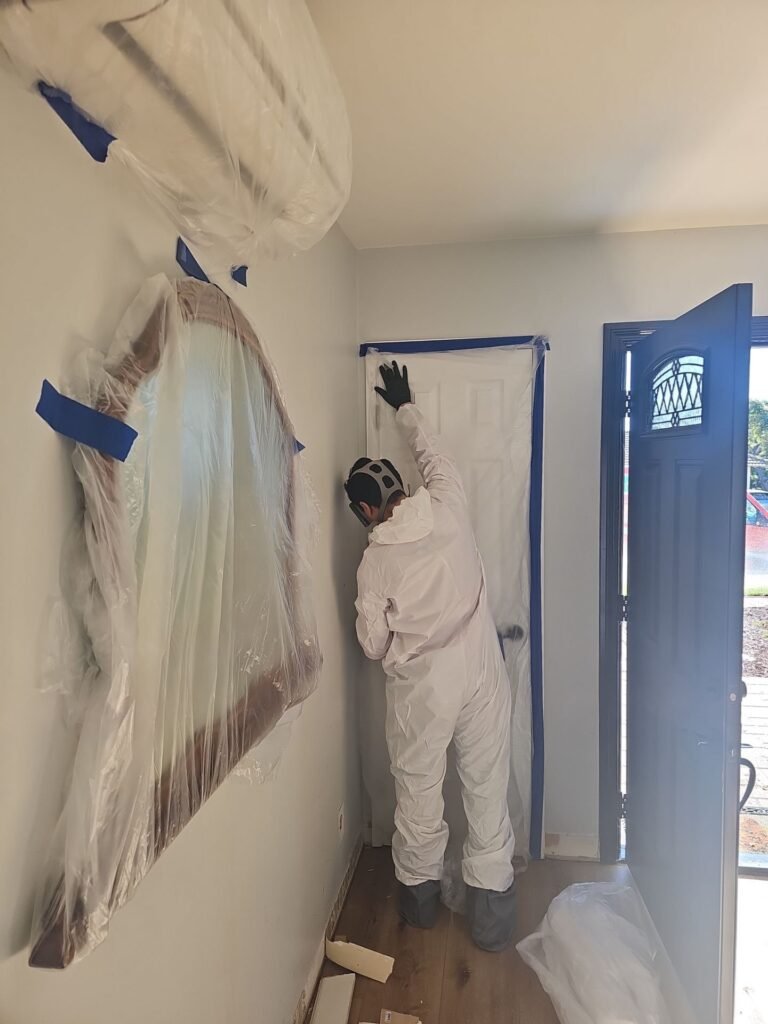
- Poly sealed across openings and floors, with HEPA vacuums running
- Wet scraping in place of dry sanding
- No torches and no high-heat guns on paint
- A cleaning verification step before any of it comes down
- Written notice to occupants before the first cut
More than half of Santa Ana households rent. The owner signing is often not the person sleeping ten feet from the plastic.
That notice belongs to whoever lives in the unit. The firm opening your walls has to hold EPA firm certification, and that is a number you can verify.
Who files the permit?
Either of you, and the two doors lead to different rooms.
Santa Ana issues most permits to the owner, an authorized agent, or a contractor holding a state number.
Solar is the outlier, where the permit goes to a contractor only. Signing as owner-builder makes you the responsible party for every phase.
Hire anyone who is not a subcontractor holding a state number and the state may treat you as an employer.
That drags in payroll taxes, workers’ compensation coverage and registration. If a worker gets hurt, exposure runs at your homeowner’s policy or at you.
What complicates it here?
Two things, and both are about who is allowed to sign.
Whoever lives in the unit is often not the person allowed to sign. In a rental the owner of record files, and a tenant cannot.
Condominiums and townhomes drag an association into the room. There CC&Rs and board approval stack on top of city requirements rather than replacing them.
Get the board moving the day the application goes in.
Refuse outright the arrangement where a contractor runs the rebuild and asks you to file as owner-builder. Strip the courtesy off and it reads: my crew, your liability.
What happens after you leave?
We finish it. There is no second company to find.
Extraction and drying, demolition, then framing, board, tape, texture, paint, base, doors, cabinets and flooring.
One crew, one file, one company answerable from wet carpet through the final coat. The crew that dries a house comes back to close it.
The address on the paperwork is 2372 Morse Ave. #30, Irvine, CA 92614.
How do the two halves price?
The split is legal rather than stylistic.
Mitigation bills hourly at $61, $69, $79 and $90, sorted by technician and equipment. Those hours show up on the cost breakdown.
Reconstruction runs on another system. California requires a home improvement contract to carry a price stated in dollars and cents.
So a rebuild gets measured, drawn and written up at one figure. Drying starts the night it happens; the number comes later.
What does signing hand me?
Three business days to back out, or seven after a disaster.
The seven applies when the work repairs a residence hit by a declared emergency. Read the notice the night you get it.
Send the address and whatever left that wall through contact. What we handle is listed on the home page, alongside the guides.
Which counter work is not ours?
An owner may file their own permit here, and on a small patch you do not need us.
Owners pull their own on small work every day. We take it on once the job reaches plan check. A drawing that comes back marked up eats the calendar.
What will you not sign off?
Three places, said now rather than later.
- The green tag comes from the city and never from us
- Anything we did not sample stays in the file as untested
- A permit wears the date the city stamped on it
The green tag is the inspector’s sign-off that the work passed. We build to what the code official will accept, and he decides.
We will not put in writing that a material is clean when it never went into a jar.
Work done without a permit gets disclosed and brought into compliance. That occasionally means opening a finished wall back up.
Nobody here will pretend the paperwork arrived first.
Who Pays to Rebuild My Condo?
Do I Need HOA Approval to Start Drying?
Cupped Hardwood Floors: Can They Be Saved?
The end of this is a closed wall with a green tag behind it and nothing to reopen later. Give us the address and the year it was built: (949) 522-4470.

Water, fire, smoke, mold, storm and sewage cleanup for Santa Ana and the Orange County cities around it. Any hour, any day. Se habla español.