The drywall dried. Do I still cut it?
Usually not. If the water was clean and the cavity behind dried too, the sheet can stay. Cutting is about what sits behind it, not the sheet. A Santa Ana crew should show you the readings that decided it, not just the verdict.
A person answers, day or night. The first look is free. CSLB #1131134 · IICRC #70194273
What does dry actually mean?
A number compared against another number, not a feeling.
The painted face has air moving across it, so it gives up water first. It is the last surface worth trusting. Behind it sits the cavity, where the argument lives.
Gypsum wicks. Water that stood two inches deep turns up a foot above the baseboard. The core pulls it upward against gravity.
The line in the paint records where the water sat, not where it went.
What can the meters see?
Less than people assume, and never the insulation.
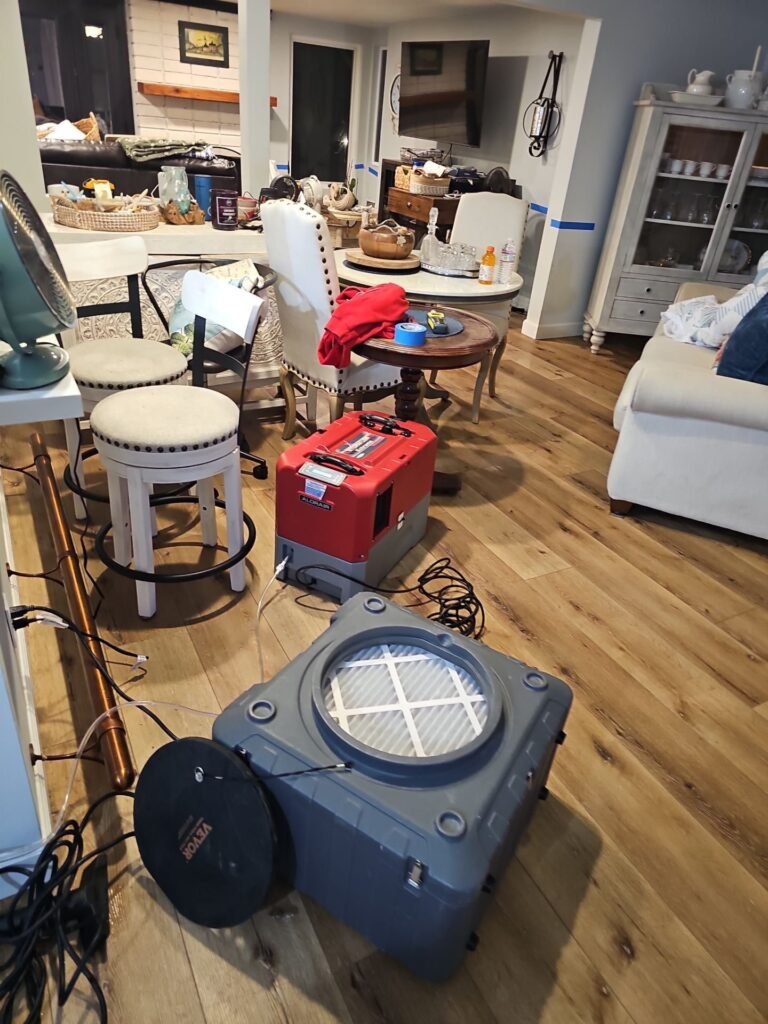
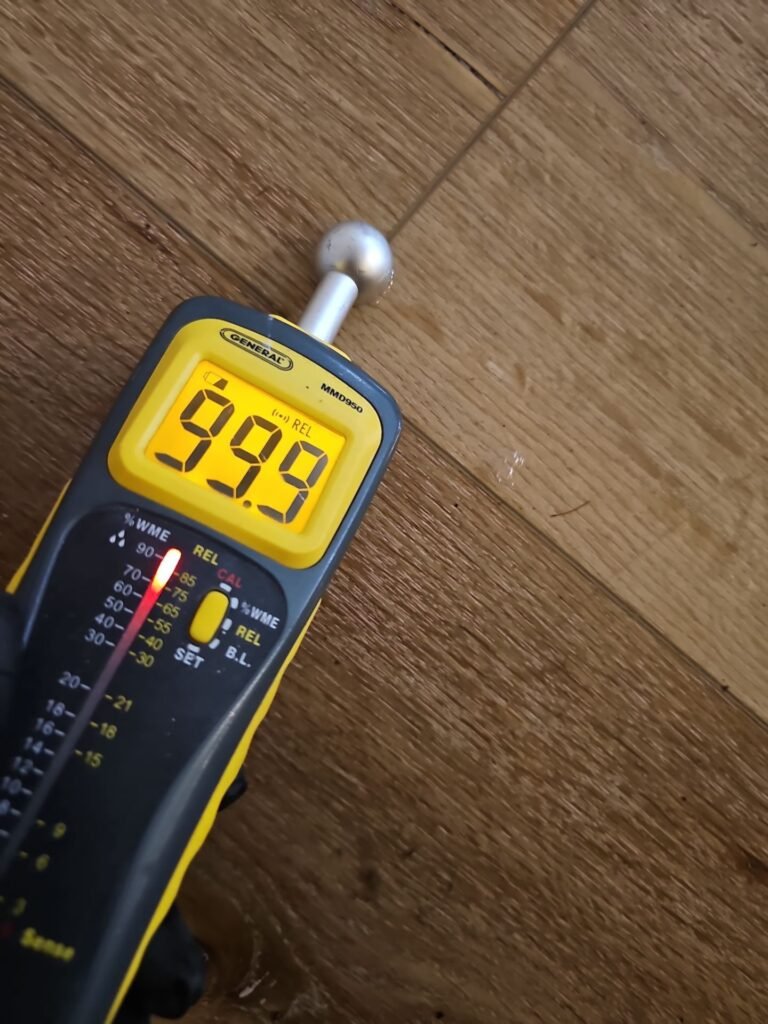
A pin meter reads the material the pins are stuck into. A non-invasive meter reads roughly the first three quarters of an inch it is pressed against.
Neither reads the fiberglass batt behind the board. Neither reads the bottom plate, the horizontal lumber the whole wall stands on.
So what counts as proof?
Comparison, and only comparison. A number alone means nothing.
It means something next to the same material, in the same house, read in a room the water never reached.
If the hallway and the bedroom read the same on one meter, the bedroom is dry. If the bedroom sits well above, that sheet is still holding water.
Readings should fall day over day and then stop, because they reached the reference. Numbers that flatten above it mean something is feeding the wall.
What is a flood cut for?
Not the drywall. For getting a hand and a hose behind it.
It takes off the bottom band, generally above the highest wet reading. The purpose is access: to the insulation, the bottom plate, the framing, the back of the sheet.
- Wet batt insulation, which slumps and will not hand water back to a fan
- Water that was not clean, because a closed cavity cannot be cleaned
- Board that already failed: a crumbling edge, a lifted seam, a bulge
- A cavity with no way in, which cannot honestly be dried shut
An interior partition with no insulation, wet from a clean supply line, caught the same day. That is a drying candidate, and cutting it is a choice, not a finding.
Can a wall dry unopened?
Yes, and it is more work than the cut.
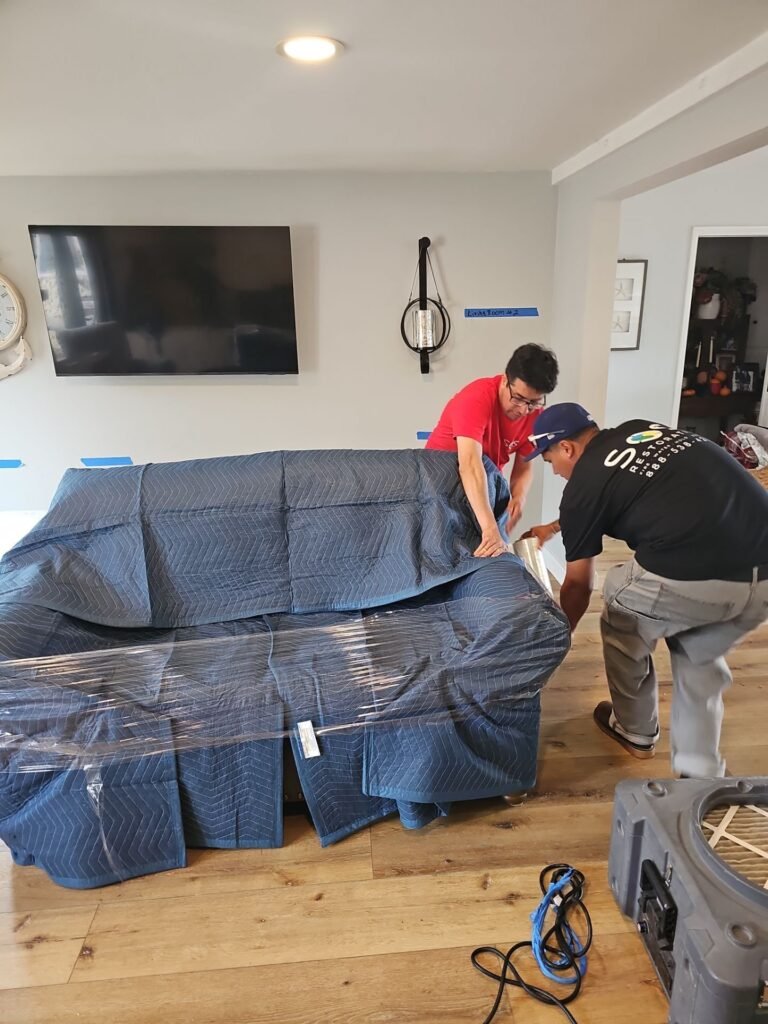
Air has to move through the cavity, not across the room. The baseboard comes off, small holes go in below its line, and the trim covers them afterward.
A dehumidifier holds the room low enough to accept the water. Then somebody comes back and reads that wall each morning until it matches the reference.
The timeline turns on the volume that soaked in, the makeup of the wall, and the humidity that day. A wall packed with wet insulation can refuse entirely.
When is painting over fine?
More often than the trade likes to admit.
- The water was clean, from a supply line, a fixture or an overflow
- The wall reads the same as one in a room that stayed dry
- Nothing is soft behind the baseboard or along the bottom foot
- Seams are flat, nail heads have not rusted, corner bead has not lifted
- Nothing smells in that room after it has been shut up a day
- The back of the baseboard is clean when you pull it off
That last one is the cheapest look inside a wall anybody gets.
Two cautions. Latex over damp gypsum peels, so the wall has to be dry through its thickness, not dry to the touch.
A stain-blocking primer stops a mark bleeding through, and it will hold back the next mark too. Know what stopped the leak before you seal over your own early warning.
Flooring asks a narrower version and answers it differently, which is why wet hardwood gets its own decision.
When does drying stop being honest?
When the wall sat wet for days before anybody touched it.
Time turns a drying question into a cleaning one. Drying does not undo growth; it stops it.
A wall that grew something over five wet days and then dried is still a wall with that in it. A dry sample is not a clean one.
If growth is present behind the board, drying the board is not a remedy for it. Whether it needs testing is a separate argument.
Do older Santa Ana walls differ?
Yes. Plenty of the older stock downtown is lath and plaster.
Plaster holds water longer, dries slower and reads oddly on a meter. Cutting into it is heavier and dirtier than cutting a sheet.
So the trade-off leans harder toward drying it where it stands. In condo and townhome construction, a wet wall may be an assembly shared with a neighbor.
Your face of it drying tells you very little about the face you cannot see.
How do I spot a habit?
Three questions, and the shape of the answer matters most.
- What did this wall read, at what height, and against what dry material
- What is inside this wall, and how do you know
- If you did not cut it, what would you do instead
Know which way the money points, ours included. A cut prices cleanly, finishes the same day, and ends the contractor’s uncertainty.
Drying in place means equipment sitting longer and somebody driving back several mornings. Neither fact proves anyone is being dishonest.
What tells you something is the order. If nobody metered that wall and compared it to a dry room before the saw, the cut was a routine.
When is cutting not worth it?
If the cavity reads dry and the water was clean, cutting buys you nothing.
It buys the contractor a bigger invoice. Ask for the reading behind the sheet. A wall that dried on its own is a wall that stays.
What cannot be answered here?
Whether your wall is dry. Nobody reads that off a photograph.
Water travels along framing and along surfaces, and it turns up in a hall closet two rooms away. What is inside your wall stays unknown until it is probed.
What your policy covers belongs to your insurer. Which side of a shared wall is yours belongs to your management company.
If the readings say the cavity is wet, opening and drying it is ordinary restoration work. The other questions have their own guides.
Cupped Hardwood Floors: Can They Be Saved?
My Deductible Is Bigger Than the Damage
Insurance Check Smaller Than the Bill?
The best version of this ends with a baseboard back on, a coat of paint, and no line on the wall to remind you it happened. Santa Ana, (949) 522-4470.
Water, fire, smoke, mold, storm and sewage cleanup for Santa Ana and the Orange County cities around it. Any hour, any day. Se habla español.