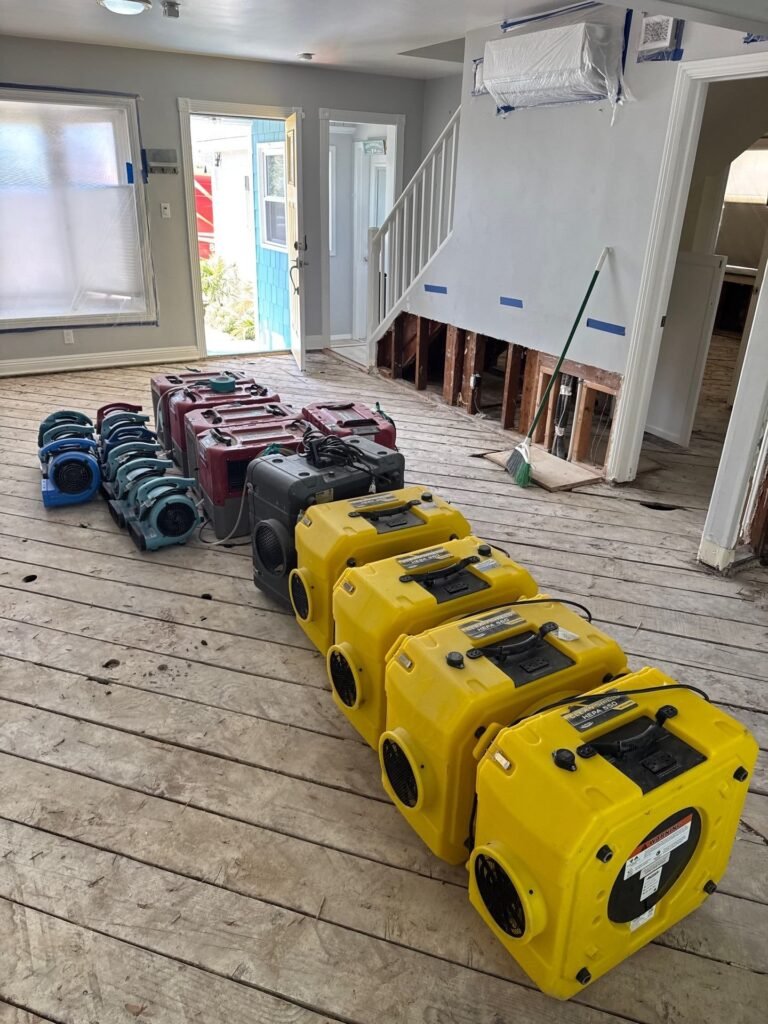
They took the fans out. Who closes it?
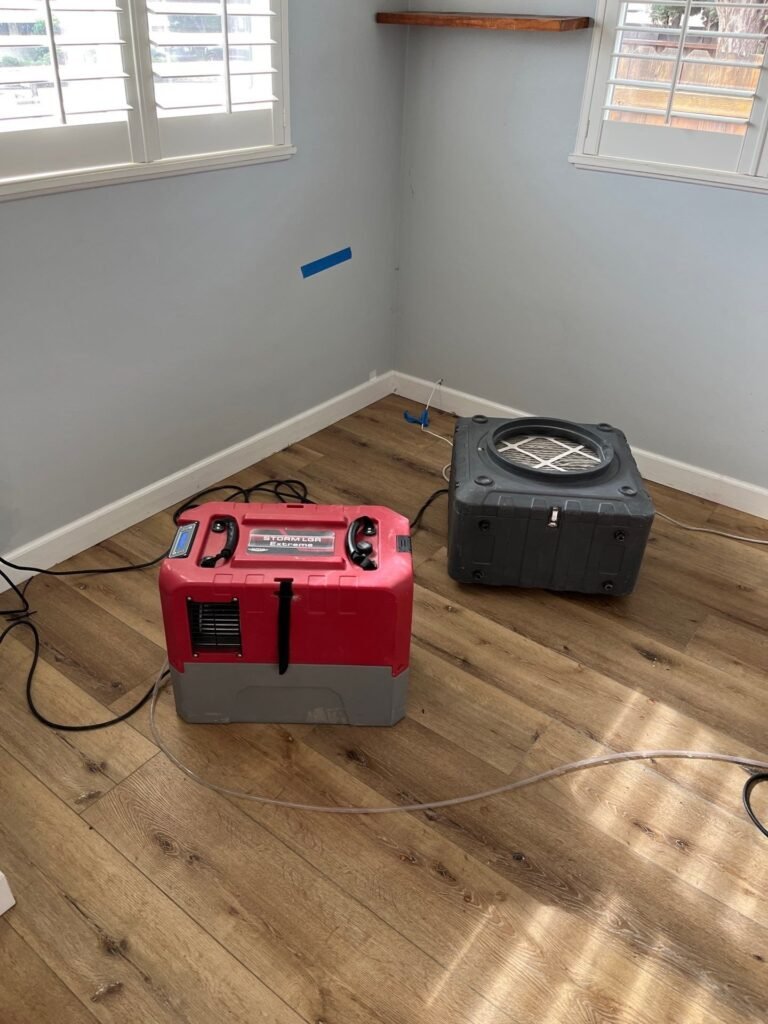
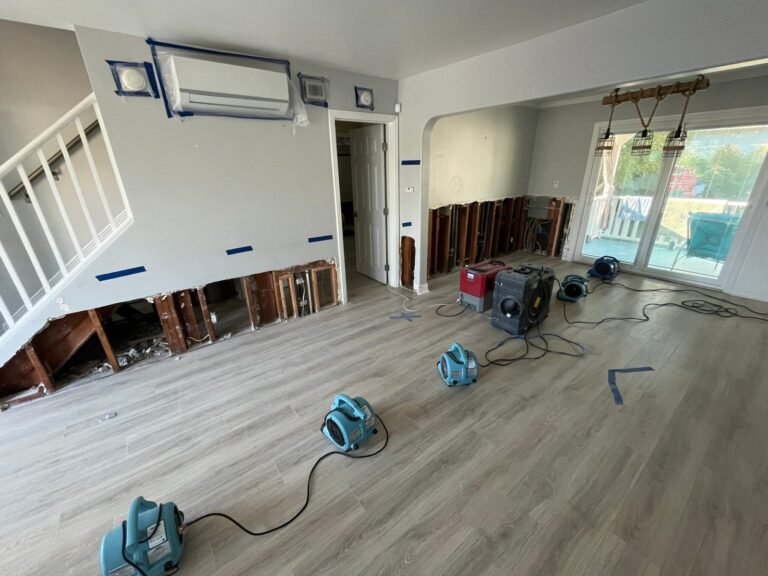
The equipment is gone. Bare studs, no baseboard, a hole in the ceiling where the light sat. That open wall is the part nobody staffed. In Santa Ana we take it on as its own trade, on its own paper.
Coming out to read the meters costs nothing. CSLB #1131134 · IICRC #70194273
Why does it stop at the fans?
You are standing between two contracts, and nobody said so.
The first is mitigation, the emergency half. Cut out what is soaked, dry what stayed, and keep it out of the next bedroom.
Nobody can say on day one how long a wet slab under a 1962 duplex takes. So that work runs on the clock.
Our labor is $61, $69, $79 or $90 per hour, sorted by task and by who is running the saw.
What is the second contract?
Putting the house back, at a written total.
Insulation, board, tape, texture, paint, base, floor, the vanity set again. California calls that paper a home improvement contract.
Section 7159 says it carries a written total in dollars, signed, before one sheet of drywall goes up.
Nobody sells a rebuilt hallway by the hour, us included. So the gap between the two is lawful; what goes wrong is the silence around it.
Does Santa Ana add its own delay?
Yes. Most housing on these blocks went up before 1980.
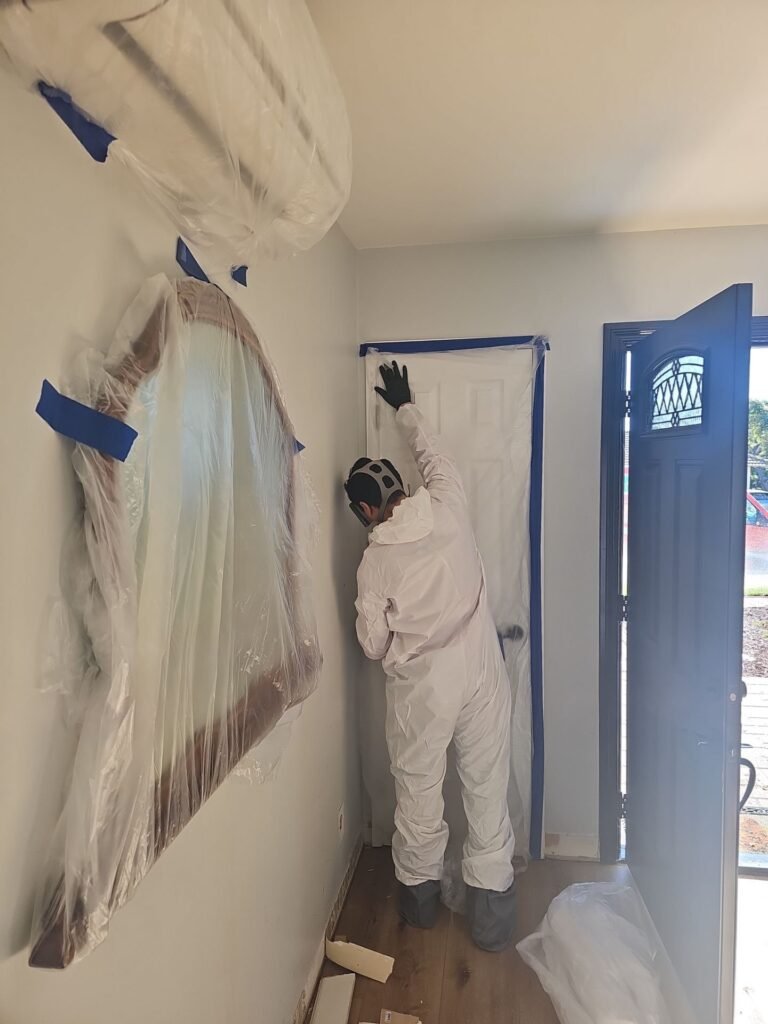
The median house here dates to the late sixties. Cal/OSHA says to treat surfacing material and pipe insulation from 1980 or earlier as asbestos, pending a lab result.
Vinyl or asphalt tile from that era gets the same treatment, mastic included.
A popcorn ceiling over a 1968 living room is not a demolition question yet. It is a sampling question, and half the time that is why your job went quiet.
Is the drying company supposed to close it?
It depends on who you hired, and ask before they start.
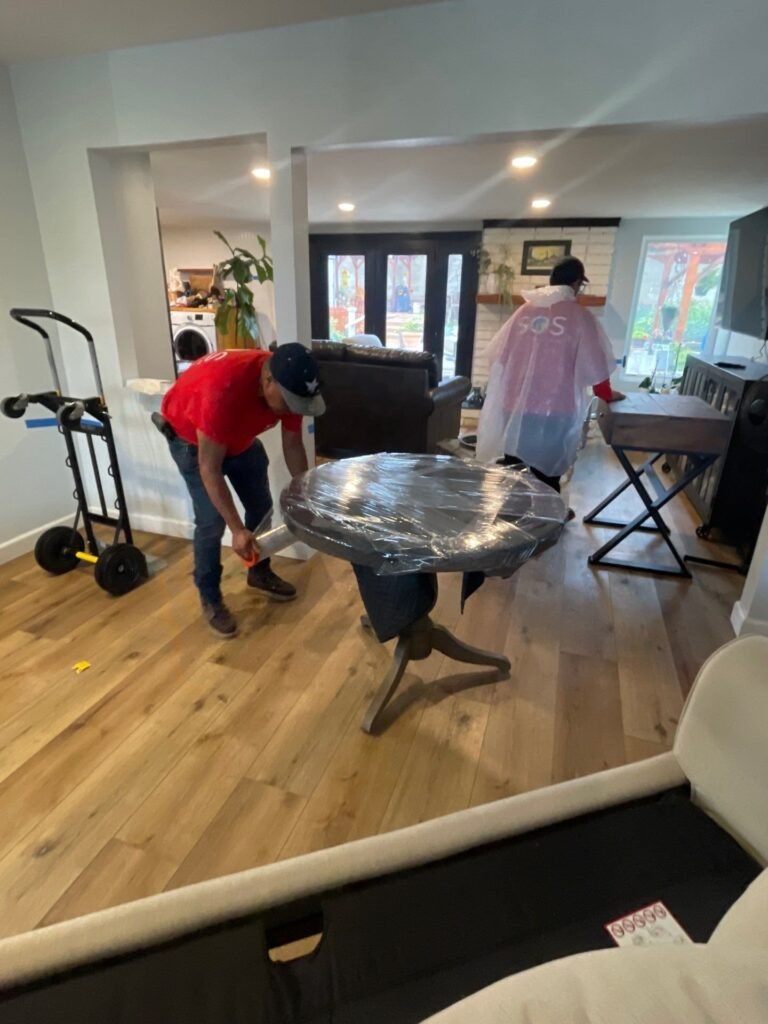
Plenty of outfits in this county dry and nothing else, and they do that well. Vans turn up, extract, cut, set equipment, chase the meter down, then load out.
They leave you a folder, and after that you go hunting for a builder yourself.
We run both halves. The reconstruction side is its own signed agreement at a fixed total. It is run by the foreman who stood there when your ceiling came down.
Which numbers should I check?
Two, and both sit on public registers.
Construction sits under CSLB #1131134. Drying, cleaning and remediation sit under IICRC #70194273.
Pull them up while the estimator is still in your driveway. Any footer can print a soothing word; a number you can check is different.
Our shop sits at 2372 Morse Ave. #30, Irvine, CA 92614, a short run down the 55.
Does the paint change anything?
On the rebuild half, yes, if it predates 1978.
The federal repair and painting rule takes over the moment a crew disturbs six square feet of painted surface indoors.
Twenty outdoors does the same, and whoever disturbs it has to be registered with the EPA. Around here, most houses are older than the rule.
What must be in my hands?
A folder, and it is what an insurer reads first.
It is the dated record of what was wet, what came out and what it took. Whether we dried the house or somebody else did, ask for all of it in writing.
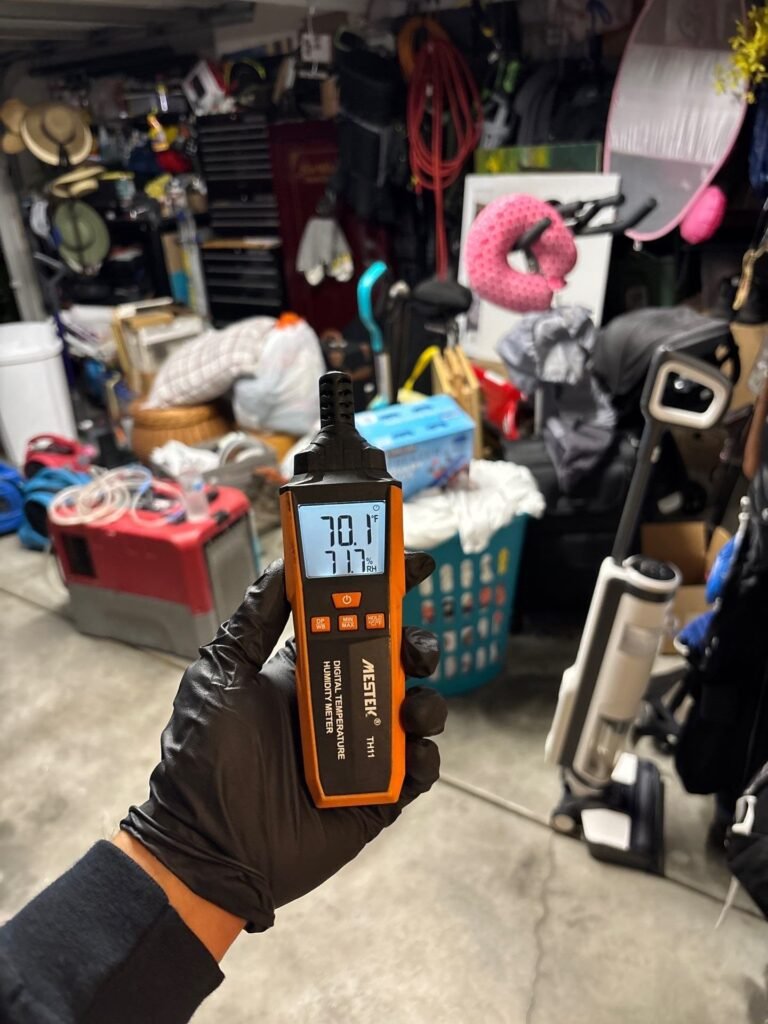
- The meter log, day by day, room by room, material by material
- Temperature and humidity beside each entry, on the dated sheet
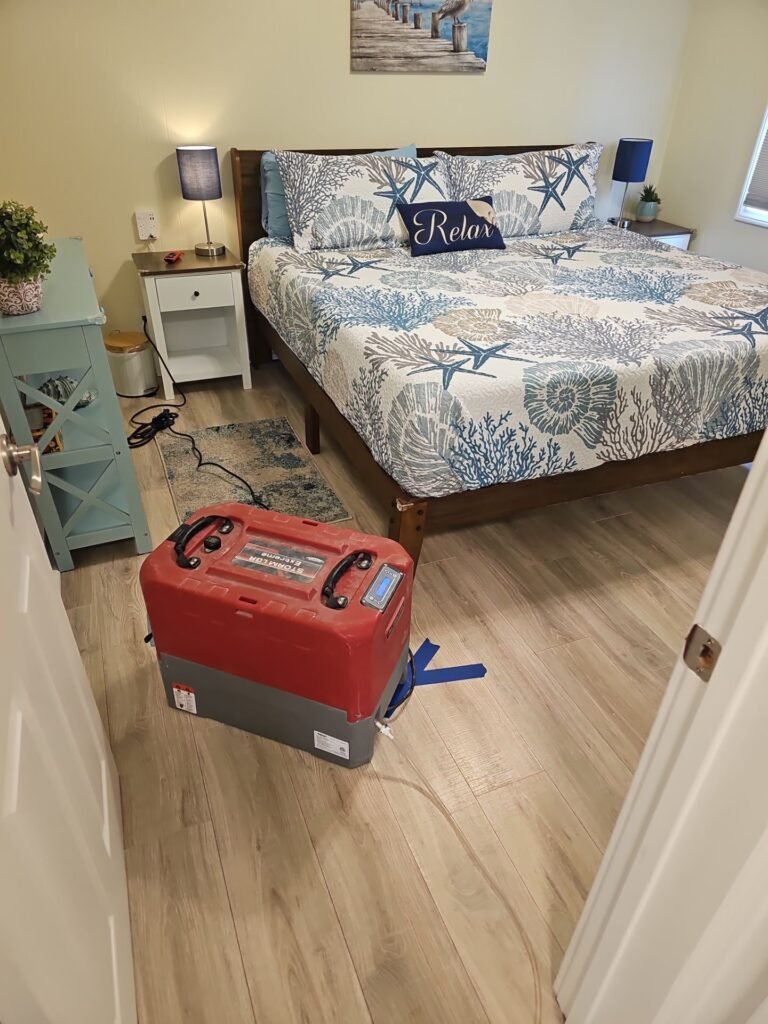
- The equipment sheet: how many movers, what capacity, which room, hours run
- Photographs before anybody cut, mid demolition, and at the end
- The hours, reading like a timecard: who, what day, what task
- A map of where the cut line stopped and what hit the dumpster
- The dry call: one dated sentence, plus the readings behind it
That map drives the rebuild number harder than anything else here. Without the dry call, nobody can say when the second half was allowed to start.
What lab work belongs in it?
The asbestos survey, lead results, and post-remediation sampling.
On any mold removal, that means samples taken after the work.
That survey is not optional here. Rule 1403 asks for a written asbestos survey by a qualified consultant ahead of any demolition or renovation.
Plus notice filed ten working days before removal starts. The only carve-out for a house touches under a hundred square feet of material still intact.
There is none at all for condominiums, townhomes or apartments, which describes much of this city.
Which trades does the rebuild need?
More hands than people picture, each stuck behind the last.
- Framing, which stalls on wet wood and on a stamped engineer’s letter
- Plumbing, which stalls on the original failure, often a split galvanized line
- Electrical, which stalls on an inspection before the board goes back
- Mechanical, once smoke entered the system or a backup reached a shared attic
- Insulation, which stalls on moisture inside the framing, not in the air
- Drywall, texture and paint, matching something sprayed decades ago
- Floor and tile, stalling on slab moisture and on whether the product exists
- Cabinets and trim, stalling on stone fabrication and a base profile
- Roof and exterior after a storm, stalling on weather
One soaked hall bath pulls in seven or eight of them. That queue is most of the answer to how long this takes.
Sequencing drives the calendar more than labor hours do, so an honest schedule tightens only once materials are locked.
And the money moves at the matching. One ruined plank in a floor running to the kitchen stops being about the plank.
It becomes a question of how far fresh material travels before your eye lets go.
Who signs the rebuild here?
It depends on what you own, and this city is mixed.
- A house you own: you sign, and a permit covers anything structural
- A condo under an association: you inside, the board for common area
- A duplex you own with tenants: you sign, with access windows and notice
- A unit you rent: the owner or the manager signs, never you
In the condo case the association’s carrier joins in, and there is no asbestos survey exemption at all.
With tenants, relocation enters if the unit is unlivable, and the pre-1978 paint rule rides along. If you rent, your belongings ride on your own renters policy instead.
One company or two?
Both are defensible. The difference is who learns your house twice.
Under one roof, nothing gets found a second time. The man who opened the wall knows how high the water wicked and which stud got sistered.
He knows the angle stop behind the vanity is seized. One photo set, one written scope, no two week hole while a stranger finds calendar room.
Splitting it has value too. A second firm pricing the rebuild is an independent check on the one that priced the drying.
What actually fails?
The middle, where everyone assumes somebody else has it.
The fix is one question on the first morning. Does the outfit drying your house also close walls?
Write down what they say. A drying outfit worth its salt turns the folder over without sulking either way.
What do I ask before signing?
Eight questions, and a contractor who bristles has answered.
- What is the total, as one figure in dollars
- What is the contractor number, and may I check it now
- Does the scope separate every room, and every trade inside it
- How much down, and when does the rest move
- How do changes get handled, before the work or on the bill
- Who pulls the permit and meets the inspector
- What placeholder budgets cover tile, fixtures and hardware
- Who stands behind the labor, and when do lien releases arrive
Read the number off the contract rather than off a vehicle door, and look it up before he pulls away.
Repair kitchen is a line. Nine sheets of half inch hung and finished, orange peel matched, two coats, is a scope.
California limits the deposit, so have him put a finger on that sentence. After it, payments should chase work that already exists.
A lien release stops a sub who never saw your money from filing a claim against your house.
What about the permit clock?
A Santa Ana permit dies when work never starts in time.
Work has to begin within a hundred and eighty days of issuance. If the answer to who pulls it is you, know what you took on.
Your right to back out belongs on that paper too. Three business days on an ordinary job, seven when an emergency was formally declared.
It goes in its own notice, with the cancellation form attached.
What happens after you leave?
We do not leave at the dry call.
Extraction, demolition, drying, then insulation, board, texture, paint, floor, trim and fixtures. Then a punch walk with you holding the list.
The hourly side closes when the structure is dry. The fixed side closes when the room works like a room again.
The same second half follows drying. It follows smoke and sewage work too.
Where do you stop?
Three places, and it is better said now.
- Arguing with your carrier is not our job
- Approvals belong to the Planning and Building Agency downtown
- We do not grade our own homework
We record what we opened, what we hauled out, what the meters read and how long it took. Whether that gets paid sits between you and your insurer’s adjuster.
If you want somebody in your corner on the money, that is a public adjuster. You hire one without us.
The cost page holds the hours. The rebuild page holds the fixed side. Reach us through contact. The home page lists the rest, and the guides take the odd questions.
Santa Ana Permits Before the Wall Closes
Condo Pipe Burst: HOA's Problem or Mine?
Drywall Dried on Its Own: Do I Cut It Out?
It finishes with you walking the punch list, a signed release from every sub who touched the house, and a room nobody visiting can tell was ever opened. (949) 522-4470.

Water, fire, smoke, mold, storm and sewage cleanup for Santa Ana and the Orange County cities around it. Any hour, any day. Se habla español.