My wood floors are cupping. Can they recover?
Most cupped hardwood in Santa Ana can be saved. A lot of it flattens once the moisture underneath is gone. What decides it is how long the water sat, whether it reached the subfloor, and whether anyone sands too early.
A person answers, day or night. The first look is free. CSLB #1131134 · IICRC #70194273
Why is it cupping?
The underside took on water and the top face did not.
Wood swells across the grain and barely along it, so a board that takes on moisture gets wider, not longer.
When the water is underneath, the bottom face swells while the top stays closer to normal. The board rolls: edges up, center low.
Where the water sat matters more than how much there was. A splash wiped up in twenty minutes usually does nothing at all.
Solid or engineered: does it matter?
It changes the entire answer. Swelling reverses; delamination does not.
Solid oak is one piece the full thickness of the plank. It swells, and given a way to release that moisture it can shrink back.
Engineered flooring is a thin layer of real wood over a plywood core, held by glue lines. What usually fails is the glue: the wear layer lifts or peels at the ends.
Look at a threshold or a floor vent to tell them apart. A solid plank shows continuous grain; an engineered one shows layers.
What is crowning?
Cupping’s mirror image: centers high, edges low.
It arrives two ways. Either the floor got dried hard from the top while the underside stayed soaked. Or somebody sanded a cupped floor flat too early.
The boards then finish drying and flatten on their own, leaving the middles proud. That second version is the expensive one.
Will it flatten on its own?
Often, at least in part, if nobody interferes.
Wood that swelled without crushing itself relaxes as it gives that water up. A floor that looked ruined in week one can look ordinary two months later.
The limit has a name: compression set. While everything is swollen, board edges press hard against their neighbors and the cells along those edges crush.
They do not un-crush. When the floor dries, those boards shrink to less than their original width, leaving permanent gaps or dished edges.
How long does flattening take?
Drying is days. Flattening is weeks, and often months.
Most flooring contractors will not sand a floor until it has held steady readings for several days running.
In many cases that means one to three months after the equipment came out. That is general practice in the trade, not a promise about your floor.
What does drying a floor involve?
Moving air through the assembly, not across the surface.
Air across the surface dries the part that was least wet to begin with. It can pull the top face down while the underside stays saturated.
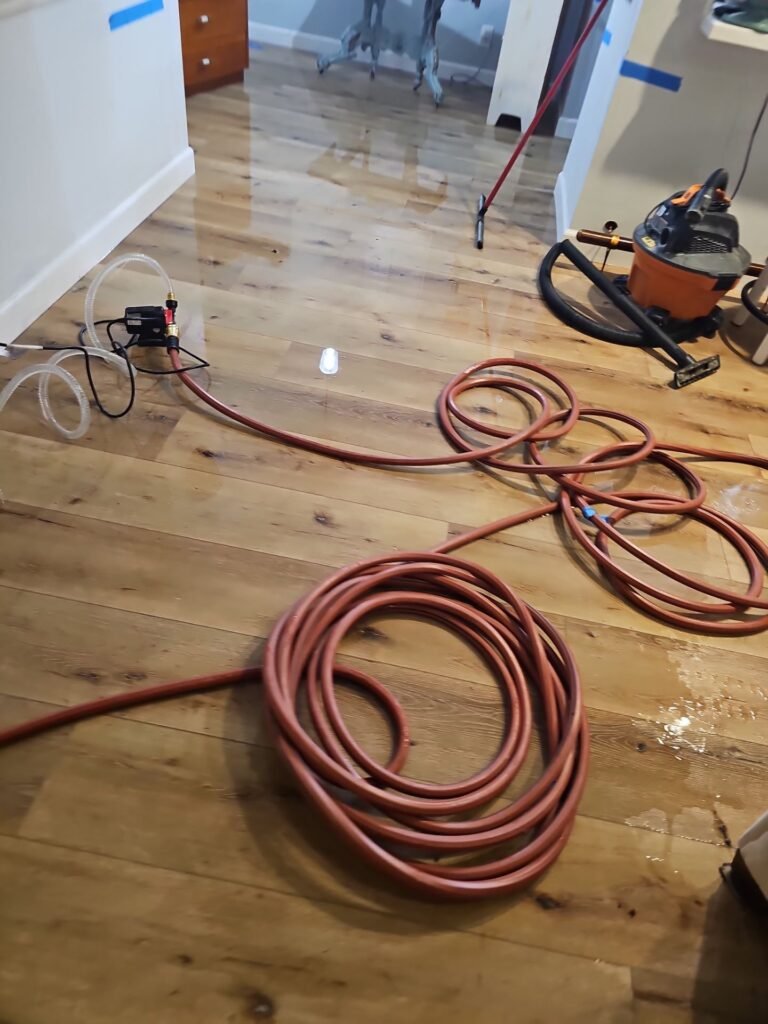
The water is under the boards, inside the tongue and groove, in the adhesive and in the subfloor. On a glued or nailed floor that means sealed mats pulling air down through the boards.
In a second-floor condo it is sometimes easier to open the ceiling below and dry the joist bay from underneath.
What decides whether it works?
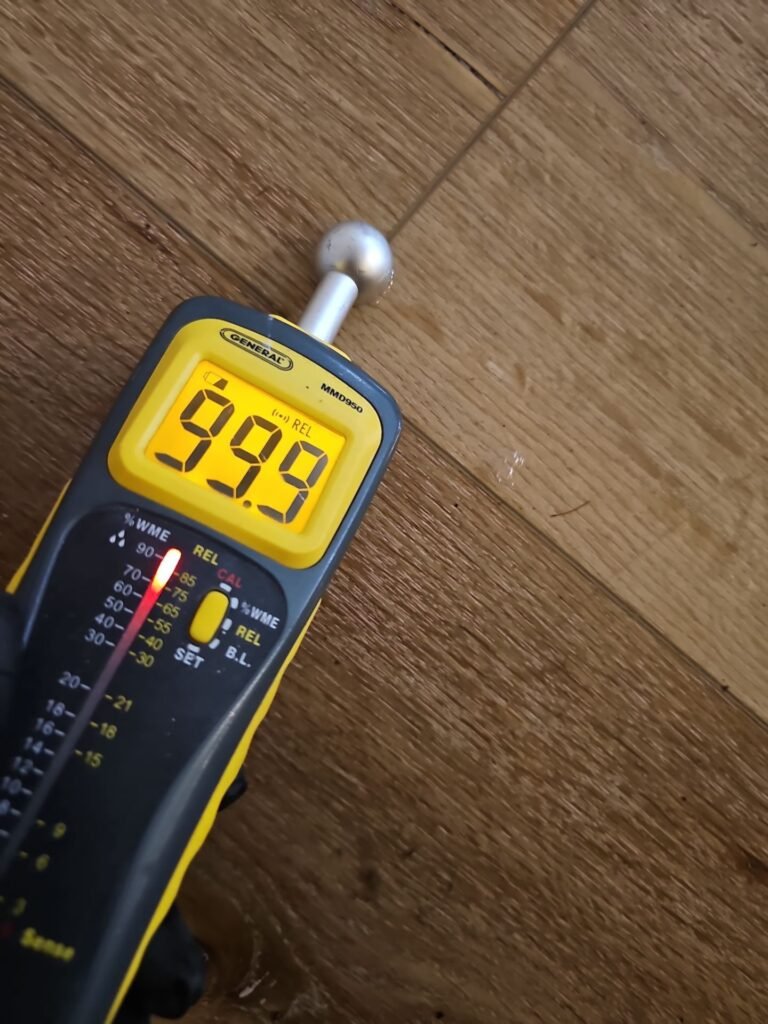
Measurement. Readings in the boards and in the subfloor.
At marked spots, taken at the same points every day, so there is a trend instead of an opinion.
A floor that is coming back shows it in the numbers before it shows it in the shape.
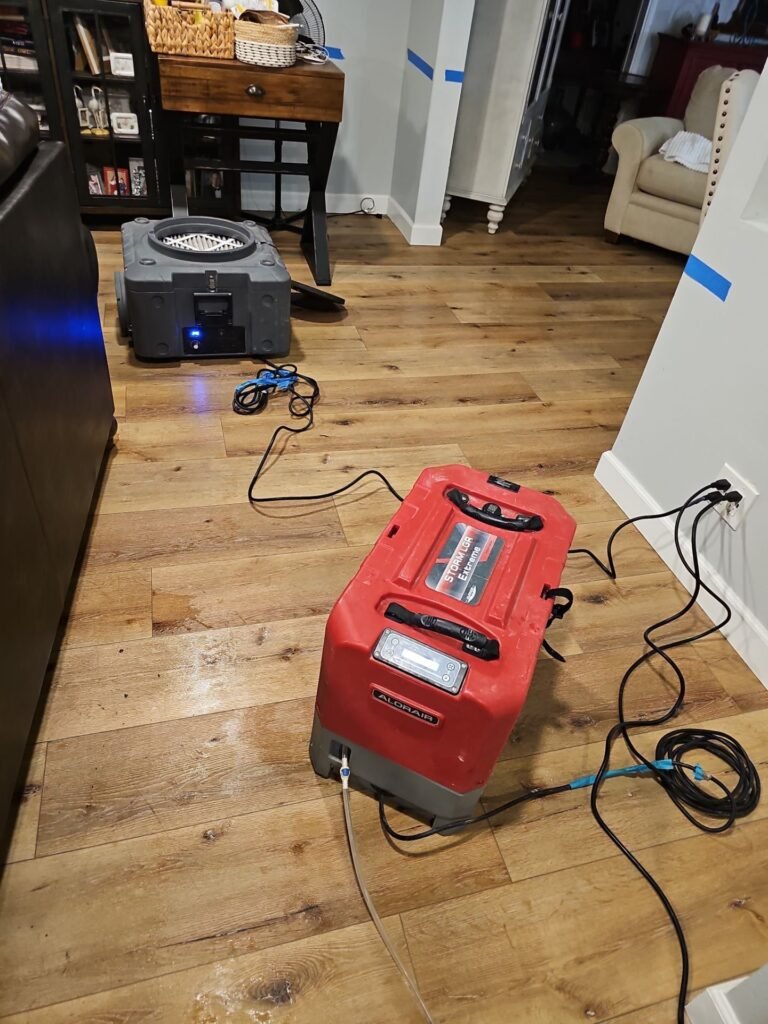
A dehumidifier runs in the room doing the real work. The mats move the moisture and it pulls it out of the air.
When is the answer no?
When the boards moved past swelling into damage that stays.
- Boards lifted off the subfloor, tented at the seams, or pulling fasteners
- Engineered planks whose wear layer separated, blistered or curled at the ends
- Water that carried sewage, or came in off the ground in a storm
- A subfloor that flexes underfoot, or plywood coming apart in layers
- A floor sanded flat two or three times already
- Growth spreading through the cavity under the boards
Then there is the case nobody enjoys. The readings come back to normal and the cup simply does not release.
Drying gives a floor its chance and does not guarantee the ending. Anybody promising an outcome before the meters have run is selling confidence.
Why is early sanding fatal?
A sander flattens whatever shape is in front of it.
It eats the raised edges first. While the boards are still swollen, that is wood the floor was going to put back on its own.
Then the floor dries and flattens. The material taken off those edges is not coming back, so every middle now stands proud.
Refinishing early brings a second problem. A film finish over wood that has not stabilized seals in what is still down there.
The finish often tells on you within a season, going cloudy or letting go at the edges.
What do I do meanwhile?
Six things, and the sixth is the one that saves floors.
- Get the rugs, the cardboard and anything plastic off the floor
- Run the air conditioning at a normal setting
- Keep space heaters off it, or you will crown the boards
- Photograph the floor now, and again as the shape changes
- Make sure the water actually stopped before you spend on flooring
- Do not let anyone start a sander
Covering a damp floor traps moisture against the top face and makes the shape worse.
Here the air conditioning is the best dehumidifier most houses own. On a gray marine-layer morning the outdoor air can be wetter than the air inside.
Opening every window then adds water rather than removing it. A strip of cupping that keeps worsening over a slab points at a slab leak.
What can a photograph not show?
Nearly all of it. A picture shows shape and nothing else.
It does not show whether the subfloor is wet, whether the adhesive let go, or whether the wear layer survived.
Two floors that photograph identically can end up in completely different places. Nor does it show how long the water sat before anyone found it.
The rest of the Orange County questions are in the guides.
What else is not ours to call?
The claim side, and the day a sander is allowed.
We do not read policy language and will not put odds on how a disagreement with a carrier ends.
Most homeowners forms draw a hard line between a sudden failure and a leak that ran quietly for months. The dated moisture log is what tells that story.
The refinishing decision belongs to a flooring contractor working from readings.
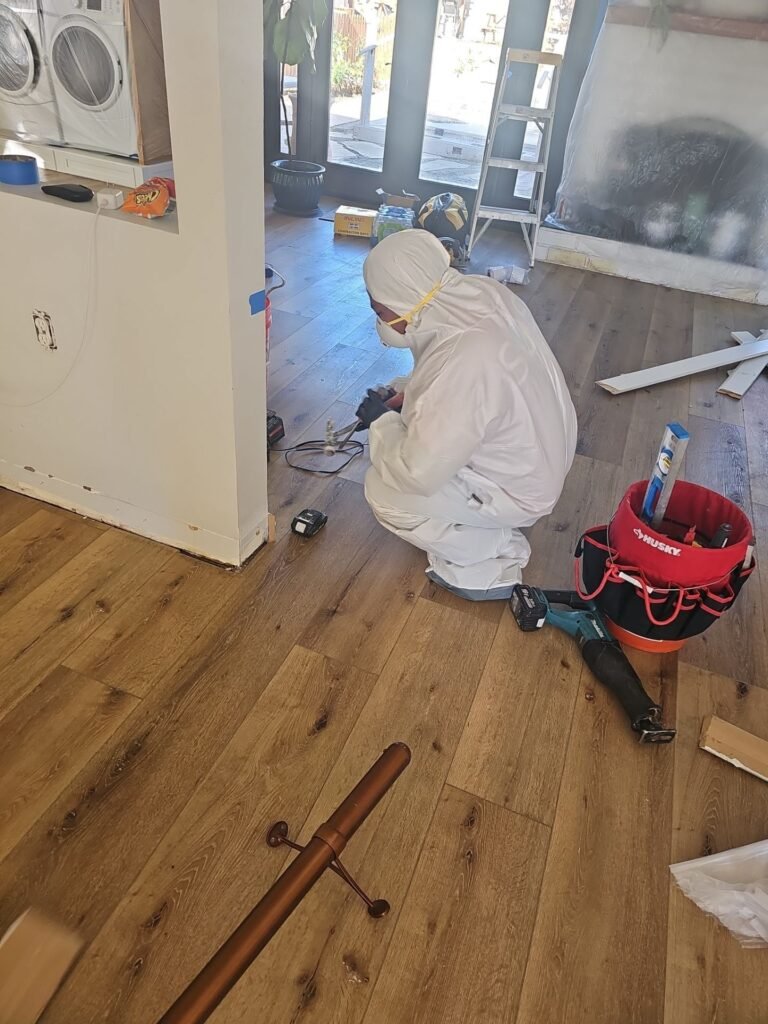
If the water also climbed the walls, drywall that dried out is a separate call. The drying underneath is ordinary restoration work.
How Wildfire Ash Gets Into a Closed House
Who Rebuilds After the Drying Crew Leaves?
What Did I Sign Before the Crew Started?
The ending worth waiting for is a hallway you cannot feel through your socks. Santa Ana, (949) 522-4470, before anybody reaches for a sander.

Water, fire, smoke, mold, storm and sewage cleanup for Santa Ana and the Orange County cities around it. Any hour, any day. Se habla español.