The garage water heater let go. How bad?
Usually less bad than it looks, and worse in one place. Most garage slabs in Santa Ana slope toward the door, so fifty gallons mostly runs out. What stays is the wall the garage shares with the house. Check that wall first.
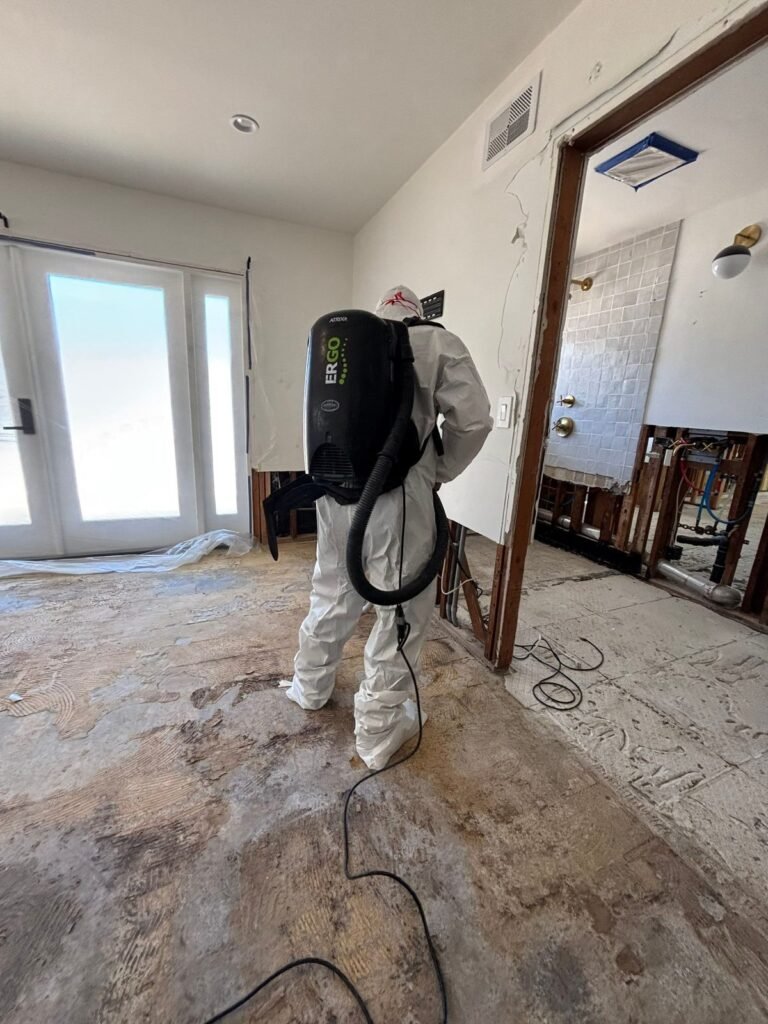
A person answers, day or night. The first look is free. CSLB #1131134 · IICRC #70194273
What do I shut off first?
Cold water first, heat second. In that order.
Close the cold water valve on top of the tank. Then kill the heat: the gas control knob at the base, or the breaker marked for the heater.
The cold inlet is the pipe that feels cool to the back of your hand. A lever turns a quarter way; a round handle turns clockwise until it stops.
When do I stop walking?
When water reaches the panel, a receptacle, or a power cord.
If it is that far across the floor, the main breaker goes off before anything else.
If you cannot reach the panel without wading, stay out of the garage and get an electrician on the phone.
What if the valve is seized?
Use the main shutoff for the whole house instead.
On most Orange County tract homes it sits on the front wall near the hose bib. Or in a lidded box by the sidewalk with the meter.
Old brass gate valves take several full turns and sometimes a wrench. They are the ones that snap, so turn them slowly.
If your heater lives in a garage closet in a condo, that valve generally serves only your unit. The building main is the management company’s.
How bad is fifty gallons?
The volume is not the problem. The dwell time is.
A tank that splits at the bottom seam empties in a few minutes. On a sloped slab with the door up, much of it is down the driveway.
The rest goes sideways. Water spreads flat and fast on a slab and finds the base of every wall. From there it is pulled into the paper facing of the drywall.
Gypsum sitting on a slab with no gap under it draws water eight to sixteen inches up within hours. The painted side can feel dry the whole time.
What gets missed afterward?
Five places, and four of them are behind something.
- The wall the garage shares with the house, and whatever backs onto it
- The bottom plate and the first foot of drywall above it
- Cabinets, shelving and anything stored flat on the floor
- The platform under the heater, and the drip pan
- The step up into the house, where water crosses the threshold
Kneel on the house side, press the carpet flat against the baseboard, and hold. Cold and heavy is water.
Why does the shared wall matter?
Behind it sits a closet, a pantry, or a bedroom baseboard.
The drywall on the garage side is thick fire-separation board, and the cavity is often insulated. Insulation holds water like a sponge and gives it up slowly.
Water crosses under the bottom plate without asking permission. Open the closet on that wall and smell it, because a damp closet announces itself first.
The bottom plate is the board bolted flat to the slab, carrying the base of every stud. It is the last thing in the room to dry.
Why do the boxes matter?
Cardboard pulls water out of the slab and holds it there.
A stack of bins against a wall keeps water flat against the drywall for days after the floor is dry. Move the boxes out before you move the fans in.
Garage cabinets are usually particleboard, which swells from the bottom up and never goes back. Whatever is soaked at the bottom of the stack tells you how high it got.
Plenty of older gas heaters here stand on a raised plywood platform. That box fills and stays full, because nothing about it drains.
Burst, or weeping for months?
The tank tells you that, not the puddle.
A sudden failure gives clean water everywhere at once, at an even height on the wall. Nothing on the tank says this was building.
- A rust stain running down the jacket from a fitting
- A crust of white mineral at the connections
- A dark ring on the slab wider than today’s water
- A chalky bloom on the bottom of the drywall
- A smell that was there before the tank let go
The temperature and pressure relief valve is its own case. It dumps water out of a pipe when either gets too high, and the tank is not automatically dead.
Nobody can put a date on a leak, us included. Readings say what a material holds today, and anyone naming a week from a picture is guessing.
Do I need anyone out?
Often not, and there is a plain test for it.
If the tank emptied onto bare slab and the water ran out to the driveway, check the shared wall. Nothing absorbent should have been sitting on the floor.
If it is dry to the palm at the baseboard on both sides, squeegee the slab. Put a box fan in the corner where it pooled and leave the door up.
Look at the base of that wall again in two days. That is the whole job, and it is free.
When is it a different situation?
When the water went under a wall and into carpet.
- The base of the drywall is darker than the rest of it
- The cabinets have swollen at the kick
- It ran through a closed door into a closet
- It sat under a platform where you cannot see it
Wet insulation in a closed cavity in a warm garage starts growing in a couple of days, not weeks. It grows on the drywall paper first.
Fans blowing across a wall do not dry the inside of it. Drying it out is ordinary water damage work. Air movers, a dehumidifier, and a reading taken in the same spot each day.
What cannot be told from here?
Whether it is wet behind your cabinets.
That answer comes off a meter placed on the material, not off a photograph.
Nor what your insurance does with it. Most homeowners forms treat a sudden discharge differently from a leak that ran quietly.
The standard form also separates the damage from the failed appliance itself.
When can I skip calling anyone?
If it drained straight to the door and the drywall reads dry, you do not need us.
Squeegee it out and open the door. The bill starts when it reached the shared wall, the insulation, or the boxes stacked against it.
What else could it be?
A slab leak, or a pinhole in a line through that wall.
Either can put water on the floor in the same corner and look identical from the doorway.
Whether the drywall comes out is a reading, not a look. That decision sits in drywall that dried out.
The floor wet again after you shut the tank off points at a slab leak. The rest are in the guides.
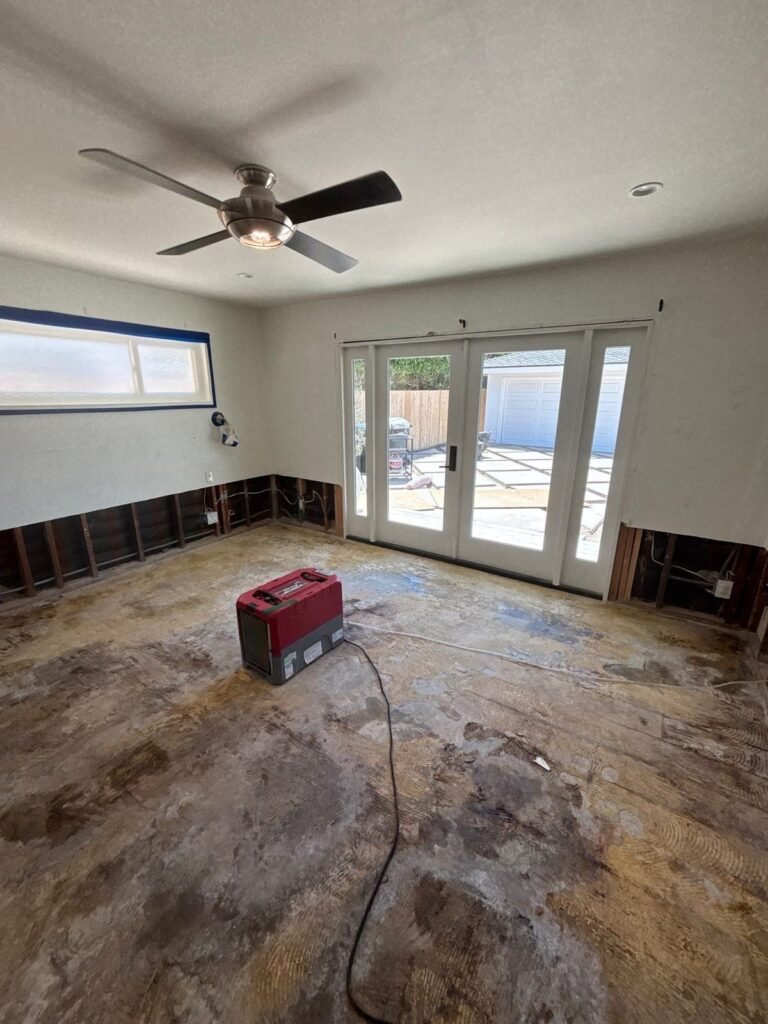
Mold Clearance Test: Who Pays for It?
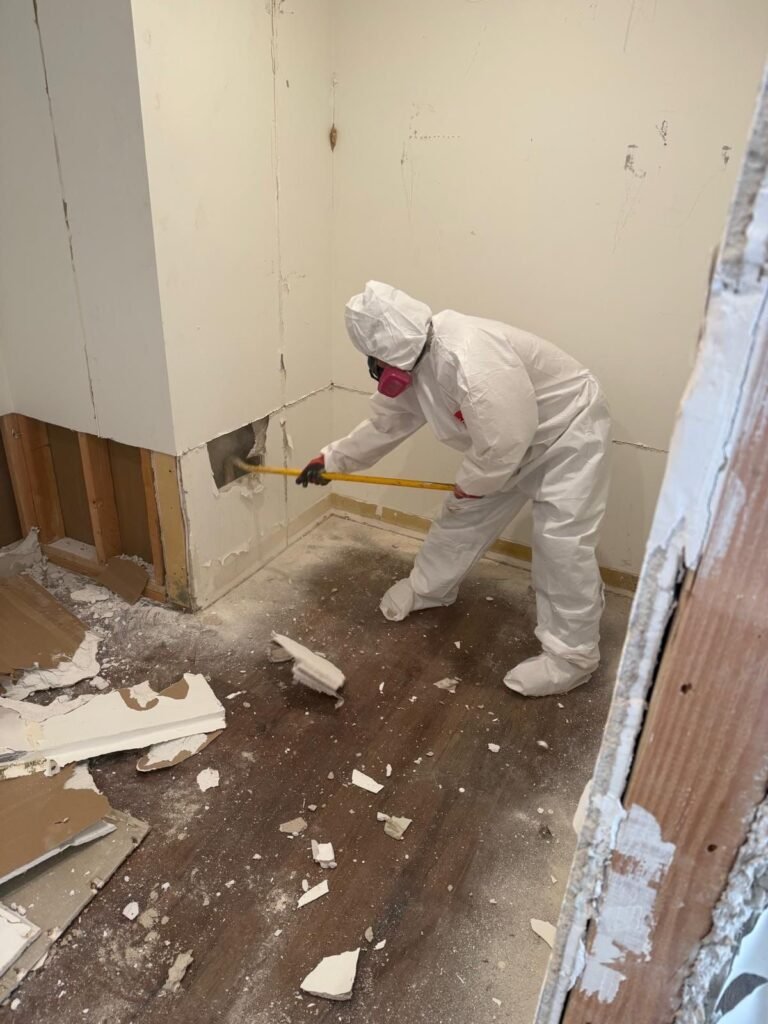
Who Pays to Rebuild My Condo?
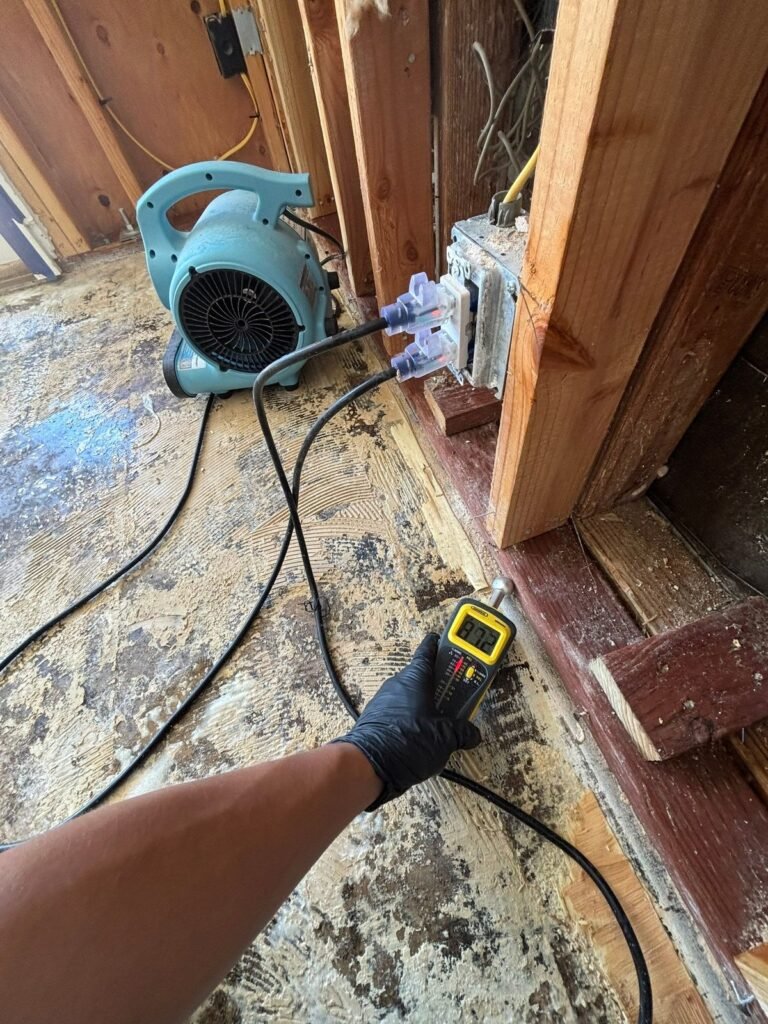
Do I Need HOA Approval to Start Drying?
The version you want ends with a bare slab, a closet that smells of nothing, and a heater that is somebody’s plumbing bill instead of your ceiling. Santa Ana, (949) 522-4470.

Water, fire, smoke, mold, storm and sewage cleanup for Santa Ana and the Orange County cities around it. Any hour, any day. Se habla español.